Using natural and synthetic polymers to develop sensors, scaffolds, and new soft materials
Click on each topic for details
Mechanosensors from oCVD
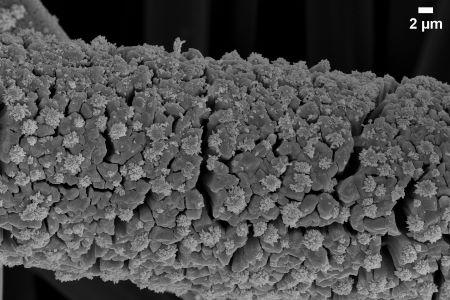
Oxidative chemical vapor deposition (oCVD) is a solvent free technique, enabling growth of network polymers in a single processing step. Deposition proceeds via vapor phase eliminating limitations of insufficient monomer solubility of conjugated polymers faced by conventional methods. In this project, we use oCVD to engineer hybrid conductive polymer composites (CPCs). These 3D porous interconnected substrates serve as a template, guiding the in-situ vapor phase polymerization of a CP backbone into the matrix by oCVD. CPCs are excellent candidates for a plethora of biomedical applications that rely on electrical conductivity, including wearable and flexible resistive strain sensors for healthcare monitoring.
People: Adrivit MukherjeePlant protection products
The demand for chemical pesticides has shot up significantly in recent decades despite the evident risks they pose to human health. There is a pressing need to switch to more environmentally friendly pest management techniques to prevent the immediate and long-term effects of pesticide exposure. Trichomes are hair-like structures on the surface of some plants that function as a physical and chemical natural defense mechanism. They can physically deter the motion of insects and immobilize them while some trichomes can also secrete adhesive compounds that can act as poisonous insect traps. Taking inspiration from nature, we aim to imitate this sticky behavior with the principle of polyelectrolyte complexation to develop trichome mimics. Mixing oppositely charged polyelectrolytes to create complexes is a simple yet promising solution in this regard.
People: Abinaya ArunachalamDouble network hydrogels using electrostatic interactions
Hydrogels are considered to be good candidates for soft human tissues replacement such as muscles or cartilages as they can match their stiffness and water content. However, usual single network hydrogels (SN) suffer from very low mechanical strength, toughness and fatigue resistance compared to native tissues. Upon deformation, the rupture of a single polymer chain triggers dramatic delocalized breakage leading to early failure. To tackle this problem, we use the double network approach (DN) which relies on the interpenetration of two polymer networks of antagonistic properties in a single sample. Our work focuses on taking advantage of the strong electrostatic complexation of oppositely charged polyelectrolytes (PEC) to introduce a rigid, supramolecular and healable sacrificial network in a DN gel architecture.
People: Julien Es Sayed Polymer Science